Today I welcome Christophe, who will share his testimony about traveling by bike.
Traveling by bike abroad: how does it work?
I get on, I press down the left pedal, the right pedal. 2500 m, 3000 m?
The drivers are stopped by roadworks. People are outside their cars. I keep moving forward. Someone shoots me at point-blank range with their telephoto lens: a drop of sweat in close-up.
A woman opens a bag containing yellow plums for me. She mumbles something in an incomprehensible language. I dip my hand in and catch a fruit on the fly. I call out a “Xie xie” (Thank you): I feel re-energized, a broad smile returns to my face.
China, Sichuan, between Ya’An (雅安) and Luding (泸定): on the Tibetan plateaus heading towards Lhasa.
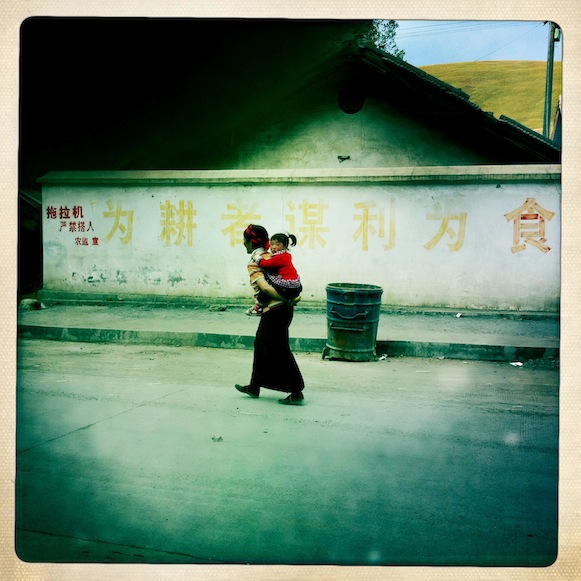
The floor is given to Christophe, from the blog Voyage Sur Le Fil, who will introduce you to bike travel, in his own words:
Traveling by bike: Pedaling = having lost your mind?
I go to work by bike, and that’s it. Cycling is not my thing! So why go abroad to cycle?
To travel slowly, see people smile at me on the roadside and interact with them, to reconnect with nature: see birds take off in the fields, smell the scents, hear the sounds… The feeling of existing is intense.
Marginal, me?
Marginal = someone who is not in the average of travelers: so cycling and sweating might seem strange, yes, I admit it.
Marginal = someone who tries to do everything oddly: NO. Cycling is perhaps, after walking, the most natural thing.
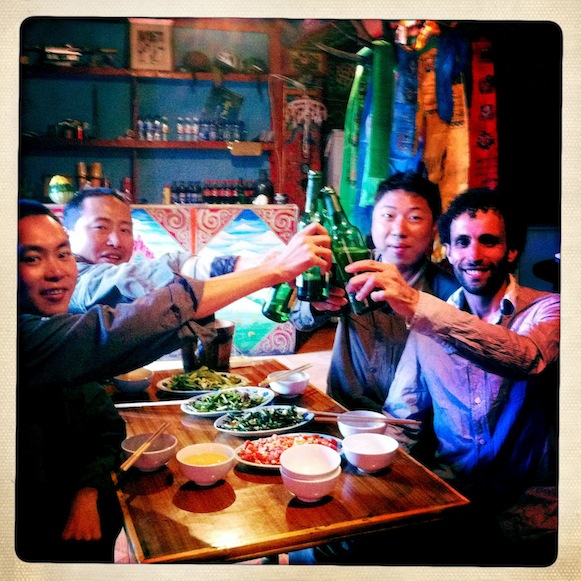
Travel diary, Thursday, in a restaurant in Kangding (康定):
Ultimately, traveling alone is better this time. What makes the difference is the route, a path where you meet locals living outside and happy to exchange a smile and a greeting. It is also being on somewhat touristy roads where people with the same ambition go in your direction or the other.
Two other important elements: at the restaurant, having a notebook to talk to someone; alone, having a book to listen to someone speak.
Traveling by bike: Physical condition
No need to be a superhuman to pedal!
Strength lies mainly in self-knowledge. Knowing your endurance limits both physically and mentally is essential.
I apply the same technique, whatever my trips: I experiment with the worst situation. I do it at home where everything is simpler if things go wrong.
For example, while preparing my trip, I made a round trip from Toulouse to the Spanish bridge, in the Pyrenees (1500 m altitude), over a long three-day weekend. I mounted my old 80s racing bike to cover 400 km and some elevation over three days.
At the end of this exhausting experience, I knew my limits. I had to plan stages of a maximum of 100 km per day.
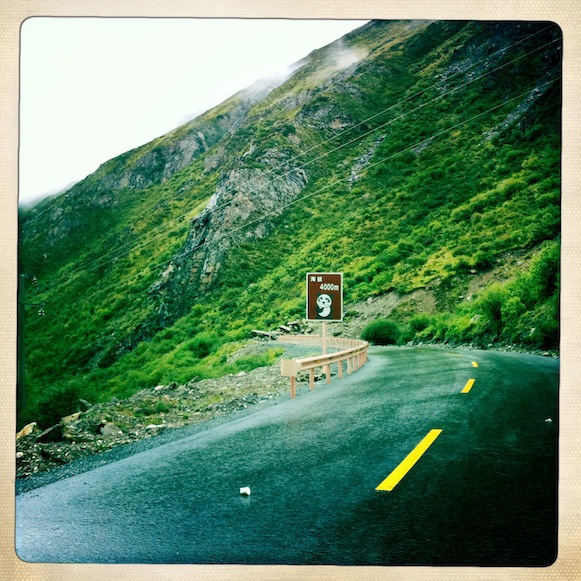
Travel diary, Friday, after Kangding (康定), first high pass at 4290 m:
I just climbed up to an altar, stupa style, and I realize every step is difficult. It wasn’t the 40 kg of the bike and gear that was hard to haul, but the 4290 m altitude!

Regaining your punch
Encounters on the road will recharge you.
People will encourage you, they would like to do what you do!
You might share the same hardship with other cyclists, which will comfort you greatly.
Travel diary, Wednesday, on the road from Ya’An (雅安) to Luding (泸定):
Sometimes, people on the roadside look at me. I greet them, they smile back. It gives me joy and energy.
Traveling by bike: Saddle soreness
Everyone has their grandmother’s remedy to treat or lessen this pain:
- Prepare yourself an hour a day for a week.
- Wear padded shorts, cycling shorts
- Choose a gel saddle
- Pedal! It relieves the weight on the saddle
- As a last resort, take an anti-inflammatory medication
Avoid at all costs following risky advice, such as “underinflate your tires” for example. That would be shooting yourself in the foot!
Travel diary, Sunday, on the road from BaMei (八美) to DanBa (丹巴):
I’m getting fed up with this track and also with the dust in my lungs. At kilometer 65 the track turns into a (bumpy) road. Will it last? I hope so!
A few kilometers later, it becomes a very bad pebble track again. It’s like cycling in a riverbed: it really kicks your butt.
Traveling by bike: What equipment and accessories?
It is often difficult, even impossible, to send the bike by mail. Because of its large size. It is one of the items you will have to buy at your destination.
The bike to choose must be comfortable and sturdy:
- Comfortable riding position
- Front suspension; for rocky paths
- Recent derailleur and shifting well uphill: so as not to lose momentum
- Effective braking: pads do the job well and can be repaired in almost any garage
The rest of the equipment should be taken beforehand. Because it is easier to find, at home, the addresses of good shops. Here is a list of bike accessories:
- 2 inner tubes
- A repair kit for inner tubes: glue, patches, sandpaper (and know how to use it)
- Plastic tire levers. Optional, a small spoon works fine
- Spare brake pads and cables
- Tools: wrenches, pliers, flat or Phillips screwdriver, Allen keys, chain link remover
- An effective bike pump (minimum 4 bars): Riding inflated will change your life!
- Powerful lighting at the front and rear of the bike: inside a dark tunnel, a weak headlamp will not suffice
- Rear rack panniers and plastic bags: to protect your belongings from rain
- A handlebar bag: to put papers, map, and compass
- A kickstand for the bike
- A detachable speedometer: to track your progress in distance and speed
- A large sturdy lock
- Items for repairs: strong tape, rope, fishing line, and needle
You can add other equipment. But a bike that is too heavy will be all the harder to haul uphill. On descents, too much weight on the rack will give you the very unpleasant feeling of a bouncy and less controllable bike.
Travel diary, Thursday, in Kangding (康定):
I go to the post office to send some of my heavy and useless stuff: 2 fleeces, 4 books, I mutilate my Lonely Planet to keep only the information on the Sichuan region, other miscellaneous items. A total of 5 kg. The post office refuses to ship all this to France! So I pack my stuff back that I will drag to the end.
Clothing
As with bike equipment, find your clothes before leaving.
A list to not forget anything:
- A fluorescent vest
- A ventilated helmet
- Gloves: to protect from falls, or from cold at altitude
- Padded shorts, of the “cycling” type
- Sunglasses
- Pants clip
- A scarf: to protect from dust (tracks, but also tunnels)
- A headlamp: in addition to the bike lighting
- Waterproof and breathable jacket with hood and underarm vents
- Waterproof pants
- Neoprene socks: against splashes from the front wheel
- Change of clothes
Travel diary, Wednesday at the 4600 m pass after Rilong (日隆):
I cover up well then set off on the descent. The wind, cold, and rain chill my forehead and fingers. I stop again to put the hood under the helmet and put on my light cotton gloves. I resume the road, but my forehead still hurts a lot. I speed up to descend and find some degrees.
Eating and drinking
You should always plan some food, even if you eat in restaurants.
Bike riding consumes a lot of your energy and the energy slump comes quickly. Cereal bars, dried fruits, and nuts are both energy-rich and light (in weight).
Water is essential. Plan at least two liters of water per day. But this can increase up to four liters, depending on sweating.
Travel diary, Friday, back in Chengdu (成都), on the scale:
I weigh myself: 53 kg. I have lost 4 kg in ten days. Damn! Didn’t I eat enough with my nuts and dried fruits? I blame myself. I would have liked to gain weight and muscle during this escape.
Pharmacy:
You must be able to treat falls: wounds, but also bruises
Muscles and tendons are heavily strained. A cream minimizing tendinitis is a good asset.
An anti-inflammatory can combat pain caused by the saddle: back or buttocks.
Preparing your itinerary and orienting yourself
The best is to find detailed maps, at a scale of 1:100,000, indicating altitude. For comparison, a classic road map of France is at 1:1,000,000.
The two measurement standards for planning each stage are distance and elevation gain.
In China, I only found a 1:4,000,000 map with a vague altitude trace. So I used Google Maps for preparations.
It is also interesting to use Google Earth, which allows displaying elevation profiles.
Plan rest days to recover. Once on the bike, if you are behind schedule you can use them to catch up on your planned distances.
On the road, the speedometer and compass help you locate yourself both in distance and direction.
It is important to observe your progress daily compared to your initial plans. In the case of a loop, you may have to turn back before the point of no return if it becomes obvious that the planned route is too difficult to complete.
Travel diary, Tuesday: SanJiang (三江) to Ya’An (雅安):
Tomorrow will be the trial by fire. If I do 50 km, my tour of Sichuan is compromised, if I do 100, it’s great!
Where to sleep, where to eat?
Going by bike means leaving big cities. This is often where the usefulness of paper travel guides ends.
To get this information, go read other travelers’ experiences on blogs or forums. You can also ask locals, for example via Couch Surfing.
Generally, if you plan to arrive in a town or village each evening, you will be assured of eating and sleeping under a roof. Whether in a hotel or at worst, under a bus shelter.
Only the midday meal might be compromised. To prepare for this eventuality, you should plan a larger reserve of water and food the evening before.
Travel diary, Monday, SanJiang (三江):
I stop in SanJiang around 7 p.m. I find a young guy, Lei Xiao. He takes me to a hotel by a small road. I freak out!
Safety, distress
Always remember to inform your loved ones of your plans! And keep them regularly updated.
So if some misadventure should happen to you, rescue services can assist you more quickly.
Buy a phone card or a SIM card to put in your mobile phone. International calls are expensive, but don’t skimp on this.
Travel diary, Sunday, on the road from BaMei (八美) to DanBa (丹巴):
My friend JingRan having returned to France, it is to her grandfather, YeYe, that I have to give my daily report. YeYe speaks only Chinese; making him understand where I am and where I’m going is epic and quite funny.
And you?
Are you itching to travel with the little queen?
Don’t hesitate to come discover my blog and my tips for traveling on the wire ;).