I have traveled several times around the world, trips of one month abroad, and even adventures lasting several months outside Europe.
Essential to remember
Withdrawal fees abroad accumulate on 3 levels: your French bank (commission + exchange), the local ATM (imposed fees), and the exchange rate. With a standard bank card, expect 5 to 7% losses. With a neobank, almost nothing.
Bank withdrawal fees abroad, which payment card to pay the least?
There is no best bank in France, each bank has a different offer and is suited to a need.Explanation of several banking terms:
- Withdrawal: this is when you make a withdrawal at an ATM
- Payment: this is when you pay with your bank card, payment card, or withdrawal card at a payment terminal.
- Fixed withdrawal fees: each traditional bank: BNP Paribas, Banque Postale, Crédit Agricole charges fixed fees of a few € when you make a withdrawal abroad if you do not have an international package.
- % Bank fees: the % bank fees are usually added to the fixed withdrawal fees and are capped at a certain amount.
- Immediate or deferred: depending on the type of payment, it is possible to pay immediately or later.
The less you pay in fees, the more you can enjoy!
How does a payment or withdrawal abroad or while traveling work?
-
In Europe in the Eurozone,
-
Outside the Eurozone,
What you need to know is that when you leave the Eurozone, you have commissions with withdrawal fees or payment fees to pay. There are several possible cases:
Did you know?
Euronet ATMs (found in almost all airports and tourist areas) charge fees of €4 to €6 per withdrawal + an unfavorable exchange rate. They are 3 times more expensive than local bank ATMs.
=> Your bank’s fixed fees! Most banks charge fixed fees plus a percentage fee depending on the amount you withdraw. If you have not subscribed to an international package, you must pay these fixed fees and bank fees.
=> The fees of the ATM’s bank depend on your country. The ATM charges a few € per withdrawal, these fees add up to your bank fees.
Several examples with a classic visa card: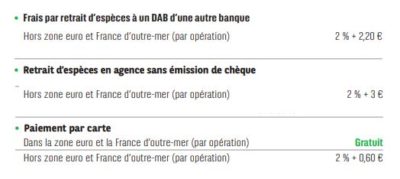 I withdraw or pay 100 € at an ATM in Germany, I pay no foreign withdrawal fees. You may be charged a commission if you exceed a certain number.
I withdraw 100 € at an ATM in Poland with a payment card, I must pay fixed fees and a percentage of bank fees, i.e. 100€ + 2€ + 2.2€ making 104 €.
I pay for a purchase of 100 € in Poland, I must pay a percentage of bank fees and fixed fees: 100 + 2€ + 0.6€ making 102.6 €.
Taking cash or cash money
I withdraw or pay 100 € at an ATM in Germany, I pay no foreign withdrawal fees. You may be charged a commission if you exceed a certain number.
I withdraw 100 € at an ATM in Poland with a payment card, I must pay fixed fees and a percentage of bank fees, i.e. 100€ + 2€ + 2.2€ making 104 €.
I pay for a purchase of 100 € in Poland, I must pay a percentage of bank fees and fixed fees: 100 + 2€ + 0.6€ making 102.6 €.
Taking cash or cash money
You can also bring cash during your trip and exchange or change money but this is not a viable solution for trips longer than one month. I sometimes carry a few hundred euros in cash as a backup but generally, I only use Visa Premier cards.
If you bring cash, avoid exchanging money at the airport because exchange rates are generally much less favorable than at exchange offices in town.
Which bank to choose and pay the least fees possible?
| Bank | Withdrawal fees | Exchange fees |
|---|---|---|
| Revolut Standard | Free (200€/month) | 0 % (weekend +1 %) |
| N26 Standard | 1.70€ or 1.7 % | 0 % |
| Wise (Mastercard) | Free (2x/month) | ~0.5 % |
| BNP, SG, CA | 2 to 4€ + 2-3 % | 2-3 % |
| Boursorama Ultim | Free (Euro zone) | ~2 % outside € |
When you spend a few months a year abroad or on a round-the-world trip, you can save a lot of money on fees and bank commissions. There are several types of banks:
Traditional banks
These are banks such as Crédit Lyonnais, Société Générale, La Banque Postale, Banque Populaire, etc.- There are traditional banks that offer international packages and those that do not. In both cases, you will pay full price.
The annual cost would be about €180 for the international option and several hundred euros for your payment card regardless of the bank, whether it is a Visa Premier card from La Banque Postale, a Visa Premier card from Crédit Agricole, or a Visa Premier card from Caisse d’Épargne.
For each payment without an international package, you will pay fixed fees of around €1 to €4 for payments or withdrawals, plus a percentage on the withdrawal or payment, usually ranging from 2 to 3%.
This can quickly become very expensive if you spend €1000 per month, which is why traditional banks are generally much more costly.
What you need to know is:
When you are under 30 years old, you can still negotiate the free issuance of a Visa Classic card or a Visa Premier card for one or two years depending on the bank.
For example, during my round-the-world trip in 2014, I managed to negotiate with a traditional bank to get 2 years free of a Société Générale Visa Premier card, but I paid for 2 years the international option of about fifteen euros which allowed me to have no fees (fixed withdrawal fees or percentage fees) on unlimited withdrawals or payments.
Although I do not recommend traditional banks for traveling, you can still benefit from advantages and it might suit you!Some examples of traditional bank offers:
The BNP Paribas Visa bank card has partnerships with foreign banks which allow you not to pay bank and fixed fees if you have free card benefits, which can be a good deal.
In Australia, BNP Paribas has a partnership with an Australian bank, Westpac.
My experience
On my first round-the-world trip, I withdrew 10 times €200 with my BNP card: €70 in fees over 4 months. On the next trip, with a Revolut + N26 card, I withdrew 30 times without paying a cent more than the interbank rate. The difference on a long trip is huge.
The payment card with international option from Société Générale costs about fifteen euros per month for unlimited payments and withdrawals at the local currency exchange rate, the same applies for Caisse d’Epargne.
Online Banks Banks with online support include Ing Direct, Boursorama, Fortuneo, Hello Bank, Monabanq, and Bforbank. Most banks usually offer good benefits for abroad.In most online banks, you do not pay fixed fees but only a percentage of bank fees (Example Boursorama or Hello Bank: 2%), which results in reducing commission costs.
Banks offer the price of a Visa Premier bank card for the price of a Visa Classic or even cheaper. The Visa Premier card allows you to have travel insurance for the first 3 months of your adventure.It also has higher limits for withdrawals and payments per week or per month.
The Visa Premier card with a good international option costs about 5 to 10 € per month, or less than 120 € per year with withdrawal fees abroad.
What you need to know:
Generally, free online banks do not offer free bank fees and fixed fees.Some banks are free for a Visa Classic or a MasterCard (Example: N26) and allow you to make some free withdrawals, but if you travel regularly, you need to get a Visa Premier card.
It is either one or the other because the bank needs to make money.
The choice is quick, there is no need for bank fee comparisons. I chose several banks since anyway, I do not need personal services because I am abroad.
PS: online bank or traditional bank, it is up to you to set withdrawal or payment limits.
Advantages
- Almost free neobanks (Revolut, N26, Wise)
- Many ATMs accept foreign cards
- Interbank rate with good cards
- Payment security by card
- Real-time alerts on app
Weak points
- Traditional banks very expensive (5-7 % losses)
- Avoid Euronet ATMs
- Daily withdrawal limits
- Risk of card blocking if travel notification is forgotten
- Hidden fees in local currency
My choice of mobile banks: N26 and Boursorama
Having only one payment card is not enough, because sometimes a payment is not accepted with one card but is accepted with another. I am especially talking about online purchases of train or bus tickets.
That is why I suggest two types of online banks: N26 and Boursorama, why?
- N26 for the advantageous currency exchange rate and no withdrawal or commission fees for a price of €6 per month (currently €10/month with unlimited transactions abroad). It is a bank without fees for international transactions or withdrawals. It is a debit card with limits that you can set.
- Boursorama for its free Visa Premier card and 2% Boursorama bank fees per withdrawal or payment. I pay online in Euro or local currency to book my accommodation or to book my plane ticket. I use this card when I cannot pay with the N26 card.
Why get an N26 card?
My opinion on the N26 Black card
One of the reasons I took this bank card is that it has no withdrawal or payment fees with the Mastercard Black card for €6 per month (now €10) which corresponds to a Visa Infinite. It offers good exchange rates with no exchange or withdrawal fees abroad.
I usually have less than 500 euros in my N26 bank account.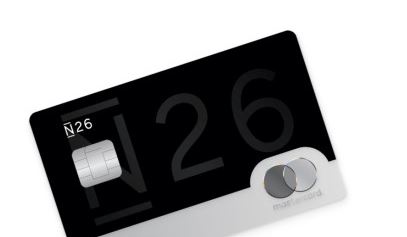 N26 is a foreign online bank, you can instantly see the withdrawal amounts with the exchange rate, which saves you from cold sweats over the exchange. It is also a simplified mobile bank and recently only the essentials are available, there is a piggy bank account where you can put savings but I have not used it.
You can change your Mastercard card PIN online and everything can be managed on mobile or online.
The N26 Black card has several guarantees:
N26 is a foreign online bank, you can instantly see the withdrawal amounts with the exchange rate, which saves you from cold sweats over the exchange. It is also a simplified mobile bank and recently only the essentials are available, there is a piggy bank account where you can put savings but I have not used it.
You can change your Mastercard card PIN online and everything can be managed on mobile or online.
The N26 Black card has several guarantees:
- Reimbursement of expenses incurred during a flight delay of more than 4 hours.
- Travel insurance
- Luggage protection in case of loss
- Protection against money theft
- Purchase protection with payment opposition.
- Reimbursement of your stolen phone if you bought it with the N26 card
If you are also interested in creating an N26 online account and enjoying the benefits, here is my referral link. You will be delighted with the Black card if you open your account, I guarantee it!
The classic trap to avoid
At the time of withdrawal, the ATM offers you “with conversion” (payment in euros) or “without conversion” (payment in local currency). Always choose “without conversion”: your bank applies a better rate than the local ATM.
Why choose a Boursorama card?
My opinion on the Boursorama Visa Premier card
Online bank offers are all roughly similar, but one of the main reasons I chose a Boursorama bank card is that it is free (Boursorama Gold card) under income conditions or requiring a minimum amount in the account. So it is an online bank without fees.


Boursorama operates like a traditional bank with an online customer service, so I have savings with them that allow me to meet the conditions to have the Visa Premier card. As a result, I have diversified savings:
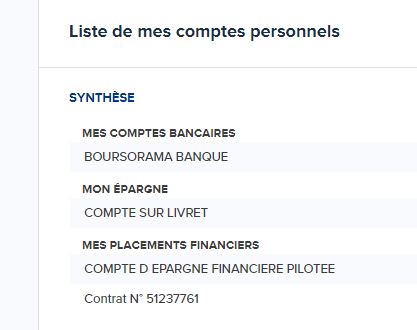
Withdrawal fees are displayed separately on the online statements so you can see the cost of the fees.
Boursorama bank in a few words:- It is the cheapest bank with the best value for money.
- Offers many additional services such as bank domiciliation service, etc.
- Accessible via the voice audio service of the Google assistant.
- with a low-end offer at €0 for the Visa Classic or Premier card.
If you are also interested in opening an online Boursorama account and enjoying the benefits, here is my referral link. You will receive €80 welcome bonus if you open your account with a bank card.
Along the same lines, the article on azimo review withdrawal provides useful insight. Our feedback on Croatia my experience also offers good pointers, and the guide dedicated to traveling for free abroad nicely rounds out the picture.
My more detailed opinion on the free Boursorama Visa Premier card (article coming soon).My choice of bank cards:
I combine the 2 cards: N26 and Boursorama because they are complementary cards with advantageous rates and I have free usage on one of the payment bank cards. It is the best solution on the current market.
I have the benefits of both cards when I travel; if I lose one card, I always have the other in case of a problem.
I generally have less than one minimum wage on the accounts of the 2 bank cards combined.
The two banks I chose require confirmation or authorization by SMS or confirmation via the N26 internet application when the online payment amount is too high, which is reassuring.
And you? What have you chosen, this type of traditional bank or online bank or a combination of several cards?
Which bank card is best for traveling abroad?
Revolut, N26, or Wise are the best for minimizing fees. Boursorama Ultim is decent within the eurozone.
Is it better to withdraw cash or pay by card?
Paying by card is generally free (with the right cards). Withdrawing is still useful for markets and small shops.
How to avoid currency exchange fees?
Use a card with no currency exchange fees (Revolut, N26 Premium, Wise), refuse “with conversion” at the ATM, pay in local currency.