.synthesis { max-width: 640px; margin: 2em auto; padding: 1.5em 1.8em; color: #78350f; font-family: “Inter”, “Segoe UI”, sans-serif; text-align: left; position: relative; box-sizing: border-box; background: #fffaf0; border: 1px solid #b45309; border-left: 6px solid #b45309; border-radius: 8px; box-shadow: 0 8px 24px rgba(251, 191, 36, 0.15); }
.synthesis h2, .synthesis .synthesis-header { font-size: 1.15em; font-weight: 700; margin-bottom: 0.6em; color: #b45309; }
.synthesis p, .synthesis li { font-size: 1em; line-height: 1.65; margin: 10px; }
.synthesis strong { color: #451a03; }
.synthesis table { width: 100%; border-collapse: collapse; }
.synthesis th { background: rgba(180, 83, 9, 0.12); color: #b45309; text-align: left; }
.synthesis td, .synthesis th { padding: 8px 12px; border-bottom: 1px solid rgba(180, 83, 9, 0.18); vertical-align: top; }
.synthesis tbody tr:nth-child(even) { background: rgba(180, 83, 9, 0.05); }
.key-takeaways { max-width: 640px; margin: 2em auto; padding: 1.5em 1.8em; color: #78350f; font-family: “Inter”, “Segoe UI”, sans-serif; text-align: left; position: relative; box-sizing: border-box; background: #fffaf0; border: 1px solid #b45309; border-left: 6px solid #b45309; border-radius: 8px; box-shadow: 0 8px 24px rgba(251, 191, 36, 0.15); }
.key-takeaways h2, .key-takeaways .key-takeaways-header { font-size: 1.15em; font-weight: 700; margin-bottom: 0.6em; color: #b45309; }
.key-takeaways p, .key-takeaways li { font-size: 1em; line-height: 1.65; margin: 10px; }
.key-takeaways strong { color: #451a03; }
.key-takeaways ul { list-style: none; padding-left: 0; }
.key-takeaways li { margin: 0.45em 0; padding-left: 0.2em; }
.mg-callout{margin:1.5em 0;padding:.9em 1.1em;border:1px solid;border-left-width:4px;border-radius:10px;font-size:.97em;line-height:1.65}.mg-callout>:first-child{margin-top:0}.mg-callout>:last-child{margin-bottom:0}.mg-callout__label{display:block;margin:0 0 .35em;font-weight:700;font-size:.82em;letter-spacing:.03em;text-transform:uppercase}.mg-callout__label::before{margin-right:.45em;font-size:1.05em;vertical-align:-.06em}.mg-callout–info{background:#eff6ff;border-color:#bfdbfe;color:#1e3a5f}.mg-callout–info .mg-callout__label{color:#2563eb}.mg-callout–info .mg-callout__label::before{content:”\2139\FE0F”}.mg-callout–tip{background:#f0fdf4;border-color:#bbf7d0;color:#14532d}.mg-callout–tip .mg-callout__label{color:#15803d}.mg-callout–tip .mg-callout__label::before{content:”\1F4A1″}.mg-callout–warning{background:#fffbeb;border-color:#fde68a;color:#7a4a10}.mg-callout–warning .mg-callout__label{color:#b45309}.mg-callout–warning .mg-callout__label::before{content:”\26A0\FE0F”}.mg-callout–danger{background:#fef2f2;border-color:#fecaca;color:#7f1d1d}.mg-callout–danger .mg-callout__label{color:#dc2626}.mg-callout–danger .mg-callout__label::before{content:”\1F6D1″}.mg-proscons{display:grid;grid-template-columns:1fr 1fr;gap:16px;margin:1.5em 0}@media(max-width:560px){.mg-proscons{grid-template-columns:1fr}}.mg-proscons__col{padding:.9em 1.1em;border:1px solid;border-radius:10px}.mg-proscons__title{display:flex;align-items:center;gap:.4em;margin:0 0 .5em;font-weight:700;font-size:.9em;letter-spacing:.02em}.mg-proscons__col ul{margin:.3em 0 0;padding-left:1.15em}.mg-proscons__col li{margin:.3em 0;line-height:1.55}.mg-proscons__col–pro{background:#f0fdf4;border-color:#bbf7d0;color:#14532d}.mg-proscons__col–pro .mg-proscons__title{color:#15803d}.mg-proscons__col–pro .mg-proscons__title::before{content:”\2705″}.mg-proscons__col–con{background:#fef2f2;border-color:#fecaca;color:#7f1d1d}.mg-proscons__col–con .mg-proscons__title{color:#dc2626}.mg-proscons__col–con .mg-proscons__title::before{content:”\274C”}ol.mg-steps{list-style:none!important;counter-reset:mgstep;margin:1.6em 0;padding-left:0!important}ol.mg-steps>li.mg-steps__item{counter-increment:mgstep;list-style:none!important;padding-left:0!important;padding-bottom:1.4em}ol.mg-steps>li.mg-steps__item:last-child{padding-bottom:0}ol.mg-steps>li.mg-steps__item>:last-child{margin-bottom:0}ol.mg-steps>li.mg-steps__item>.mg-steps__title{margin:0 0 .25em;font-weight:600}ol.mg-steps>li.mg-steps__item>.mg-steps__title::before{content:counter(mgstep) “. “;opacity:.45;font-weight:500;font-variant-numeric:tabular-nums}ol.mg-steps>li.mg-steps__item:not(:has(.mg-steps__title))::before{content:counter(mgstep) “. “;opacity:.45;font-weight:500;font-variant-numeric:tabular-nums}.mg-kpis{display:grid;grid-template-columns:repeat(auto-fit,minmax(140px,1fr));gap:14px;margin:1.5em 0}.mg-kpi{padding:1em .9em;border:1px solid #e5e7eb;border-radius:12px;background:#f9fafb;text-align:center}.mg-kpi__value{display:block;font-size:1.7em;font-weight:800;line-height:1.15;color:#111827}.mg-kpi__label{display:block;margin-top:.35em;font-size:.85em;color:#6b7280;line-height:1.35}
.wp-block-image,.ai-image{margin-bottom:1.75em}.wp-block-image>figcaption,.ai-image>figcaption{margin-top:.5em}
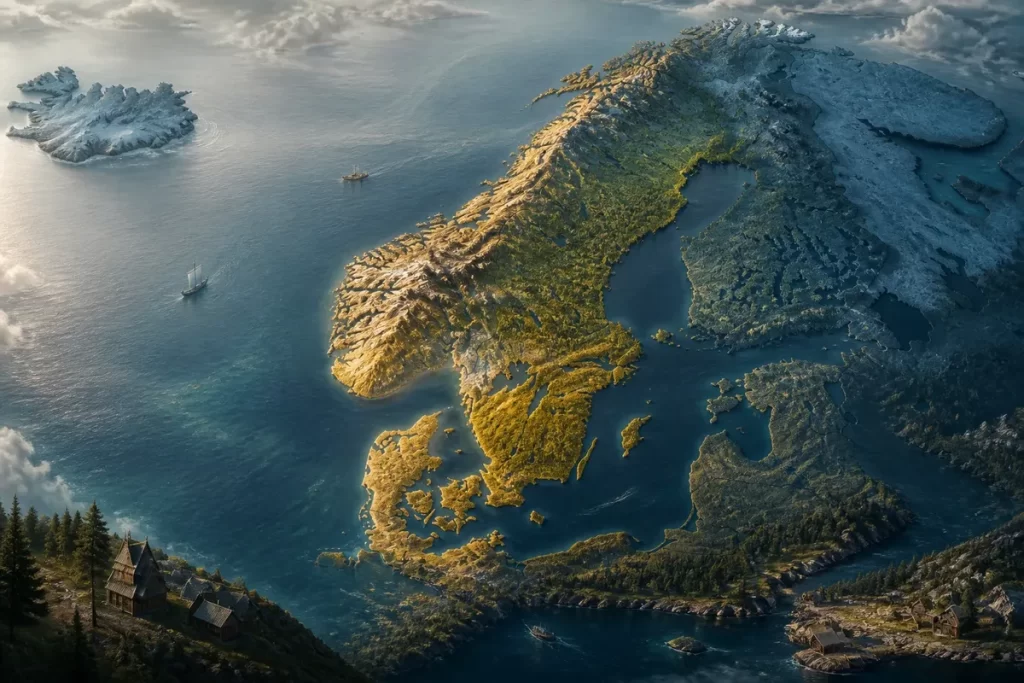
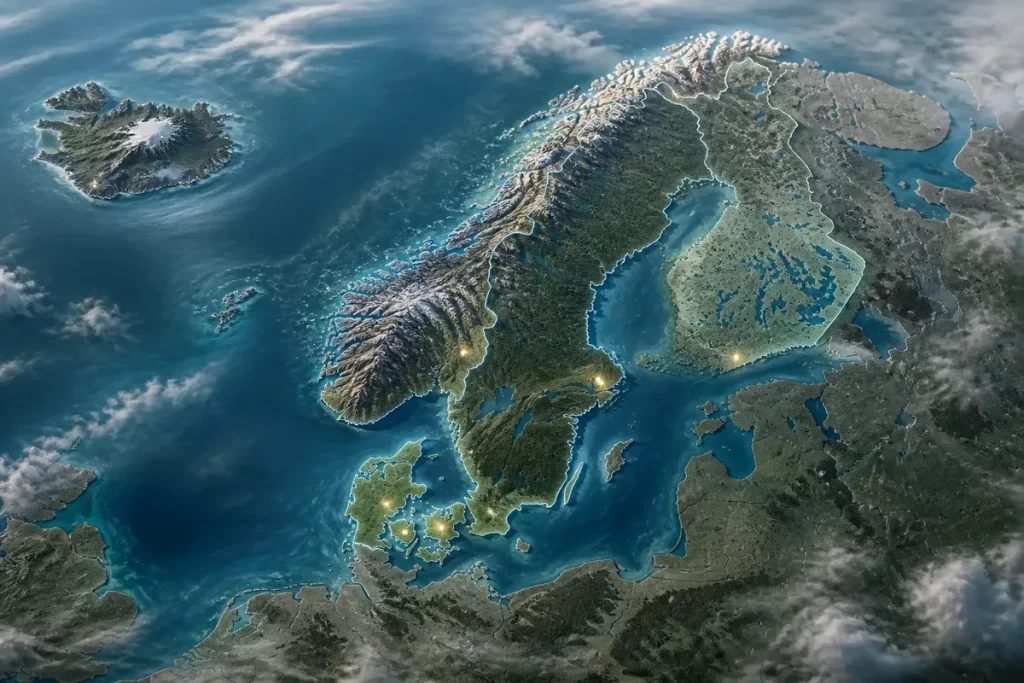
5 countries are often commonly referred to as Scandinavian: Sweden, Norway, Denmark, Finland, and Iceland. However, the strict geographical and historical definition includes only 3 countries: Denmark, Norway, and Sweden.
The confusion arises from the association between Scandinavia and Nordic countries. The five states belong to Northern Europe and share a regional history, but Finland and Iceland are more precisely classified among the Nordic countries.

| 📌 | Common list: Denmark, Norway, Sweden, Finland, and Iceland. |
| 🧭 | Strict definition: Denmark, Norway, and Sweden. |
| 🌍 | Nordic group: the five countries, plus the associated autonomous territories. |
| 🏛️ | Capitals: Copenhagen, Oslo, Stockholm, Helsinki, and Reykjavik. |
| 🗣️ | Languages: Danish, Norwegian, and Swedish are Germanic; Finnish belongs to another family. |
| ⚠️ | Note: specify the definition used to avoid ambiguity. |
The 5 countries often called Scandinavian
In a list intended for the general public, the five countries are Denmark, Norway, Sweden, Finland, and Iceland. This list mainly corresponds to the Nordic group, which the media and tourist content sometimes shorthand as Scandinavia.
1. Denmark
Denmark belongs to Scandinavia in the strict sense. Located between the North Sea and the Baltic Sea, it forms with Norway and Sweden the historical and linguistic core of the region; its capital is Copenhagen.

The country includes the Jutland peninsula as well as a group of islands, including Zealand. The Danish kingdom also includes Greenland and the Faroe Islands, two autonomous territories not counted here as additional states.
Danish is part of the North Germanic languages. It is related to Norwegian and Swedish, although oral comprehension sometimes requires particular familiarity.
2. Norway
Norway is one of the three Scandinavian countries in the traditional sense. It stretches along the western coast of the Scandinavian Peninsula, between Sweden, Finland, and the North Atlantic, with Oslo as its capital.
Its terrain explains much of its geographical identity: the coastline is cut by fjords, while mountains occupy a significant place in the interior of the country. The distance between regions matters a lot locally.
Norwegian belongs to the North Germanic languages. Its two official written forms, bokmål and nynorsk, result from a particular linguistic history.
3. Sweden
Sweden completes the Scandinavian trio recognized by the strictest historical and cultural definition. It occupies the largest eastern part of the Scandinavian Peninsula, with Stockholm as its capital and main urban center.
Swedish is closely related to Danish and Norwegian. These languages share common Germanic roots, which explains some vocabulary similarities despite different pronunciations.
Sweden combines vast forested areas, a long maritime frontage, and cities very far apart from each other. With this territory, a quick itinerary gives an incomplete picture of the country.
4. Finland
Finland is often added to lists of five, although it more rigorously belongs to the Nordic countries. Helsinki is its capital, and the country maintains close political, economic, and cultural ties with the three Scandinavian countries.

The clearest difference appears in the language. Finnish belongs to the Uralic family, unlike Danish, Norwegian, and Swedish, which are North Germanic languages.

Regional proximity remains strong. Borders, exchanges, and Nordic cooperation explain why Finland is regularly grouped with its neighbors in general articles and travel itineraries.
5. Iceland
Iceland is also included in the broad definition of the five Scandinavian countries. This North Atlantic island is a Nordic country, with Reykjavik as its capital, and has a historical closeness with Norway, Denmark, and other Nordic societies.

Icelandic is a North Germanic language, like Danish, Norwegian, and Swedish. This linguistic kinship alone is not enough to automatically place Iceland within strict Scandinavia, which also relies on geographical and historical criteria.
On site, insularity greatly changes distances and travel. Iceland is geographically close to the Nordic area, but it is not the same as the Scandinavian Peninsula.
Why do we also talk about 3 Scandinavian countries?
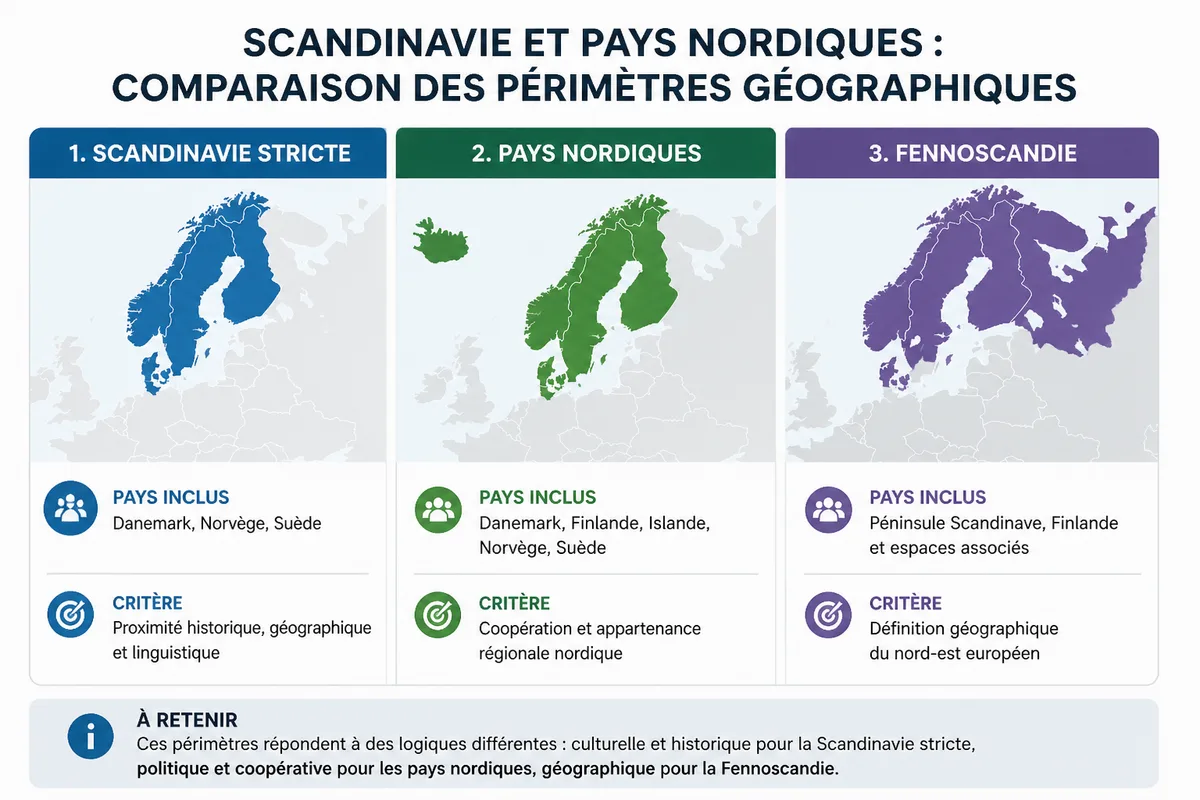
Fennoscandia is yet another geographical concept. It generally refers to the Scandinavian Peninsula, Finland, and Karelia, which shows why geographical terms do not perfectly overlap.
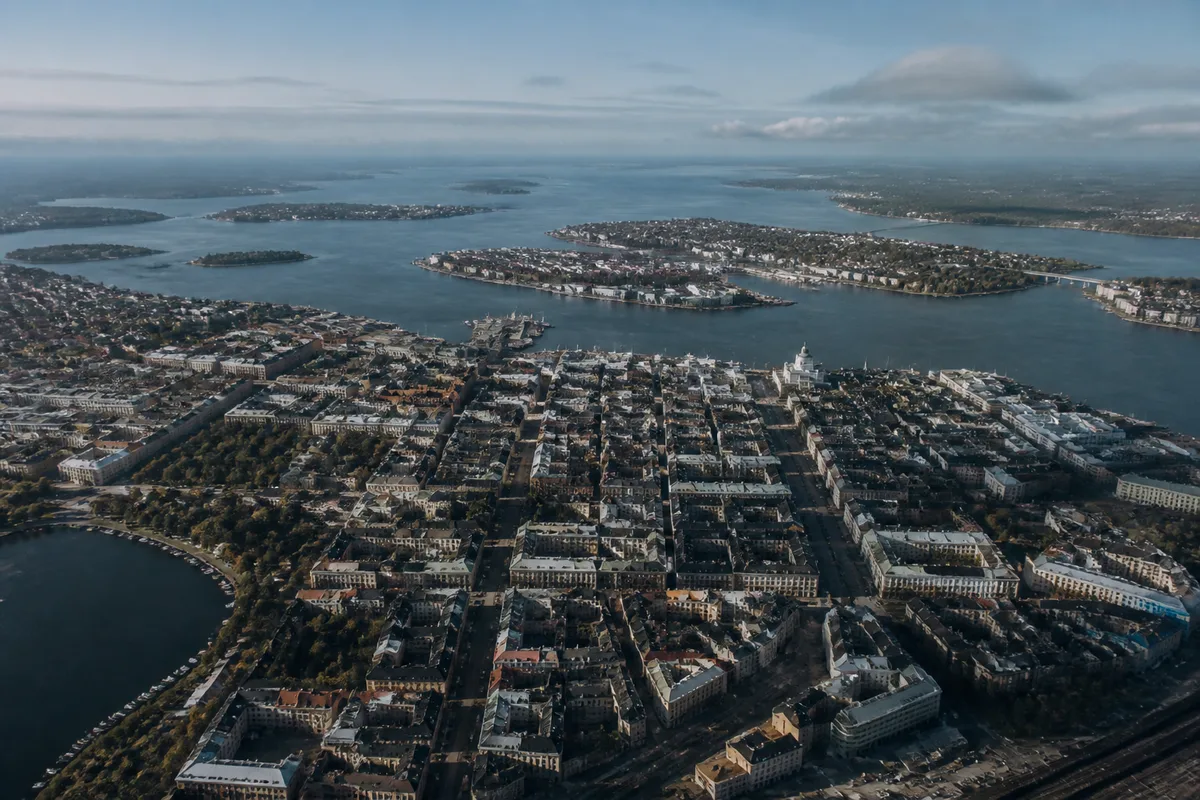
Finland is Nordic without being Scandinavian in the strict linguistic sense.
The belief that “the five Scandinavian countries are simply the countries of northern Europe” is therefore incomplete. Climate or latitude alone are not enough: language, history, and the geographical scope considered change the answer.
Scandinavia or Nordic countries: what is the difference?
| Group | Countries concerned | Main criterion |
|---|---|---|
| Strict Scandinavia | Denmark, Norway, Sweden | Historical, geographical, and linguistic proximity |
| Nordic countries | Denmark, Finland, Iceland, Norway, Sweden | Cooperation and Nordic regional belonging |
| Fennoscandia | Scandinavian Peninsula, Finland, and associated areas | Geographical definition of northeastern Europe |
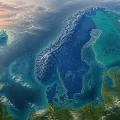
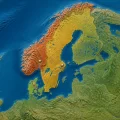
To visualize the borders, capitals, and position of each state, a map of the Scandinavian countries usefully complements the distinction between peninsula, kingdom, and Nordic region.
The Nordic Council uses the framework of the Nordic countries to bring together the five states as well as associated territories. This regional organization does not, however, transform the strict definition of Scandinavia into a list of five countries.
Territories Associated with the Nordic Countries
Greenland and the Faroe Islands belong to the Kingdom of Denmark with an autonomous status; therefore, they are not added as sovereign countries to the list of five. The Åland Islands are associated with Finland, while Svalbard falls under Norway.
The Faroe Islands have been an autonomous community within the Kingdom of Denmark since April 1, 1948, while Greenland has had the status of a special community since May 1, 1979, according to institutional information from the French Senate.
These territories may appear on a map of the Nordic area, sometimes with their own institutions and symbols. Locally, their identity is very real; however, in a count of states, they do not replace either Denmark or Norway.
To deepen historical vocabulary, the article dedicated to why we say Scandinavian countries helps to place this term in its context.
Capitals and Quick Reference of the Five Countries
When preparing an itinerary, do not automatically group the five countries into the same trip. The distances between Copenhagen, Stockholm, Oslo, Helsinki, and Reykjavik involve very different transportation and seasons.
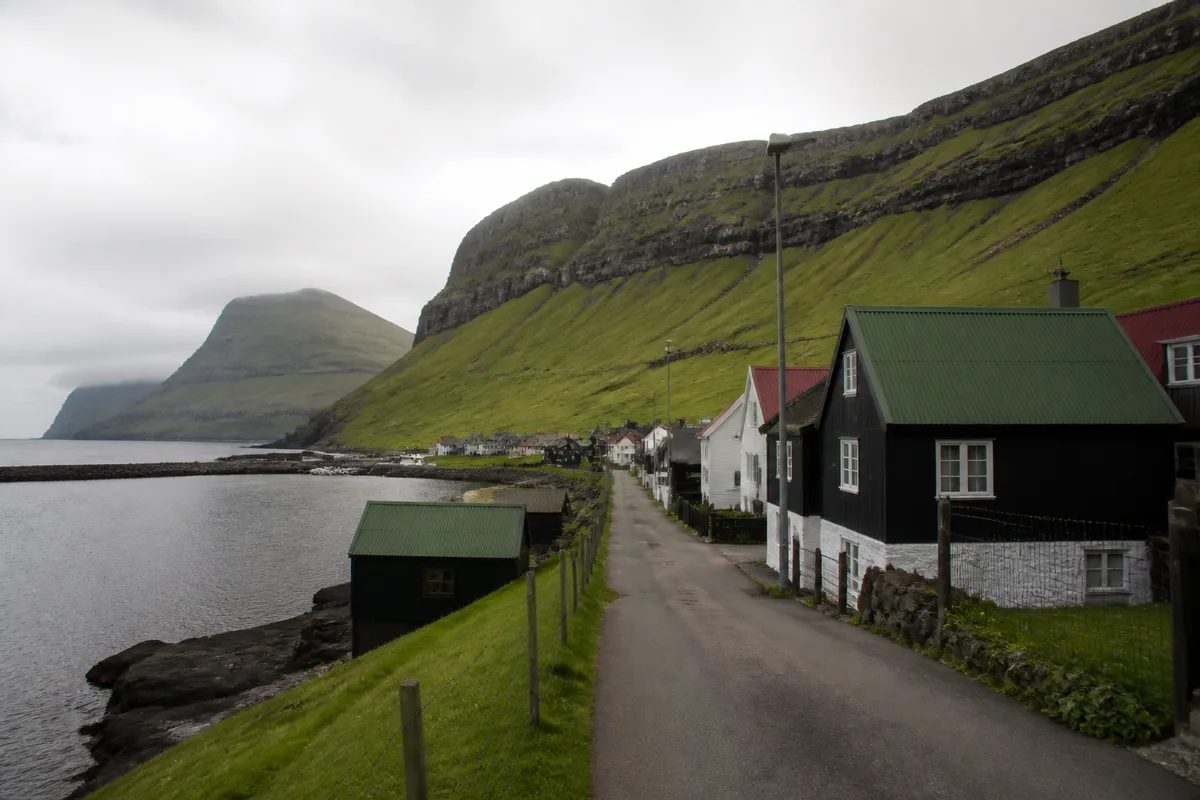
A stay focused on Denmark, Norway, and Sweden corresponds more to classic Scandinavia. A tour including Helsinki or Reykjavik falls under a broader Nordic approach, with more time devoted to travel.
The Right Term to Use Depending on the Context
To simply answer the question what are the 5 Scandinavian countries, give the five expected names, then immediately add the clarification about the three strict countries. This formulation meets common vocabulary without sacrificing geographical accuracy.
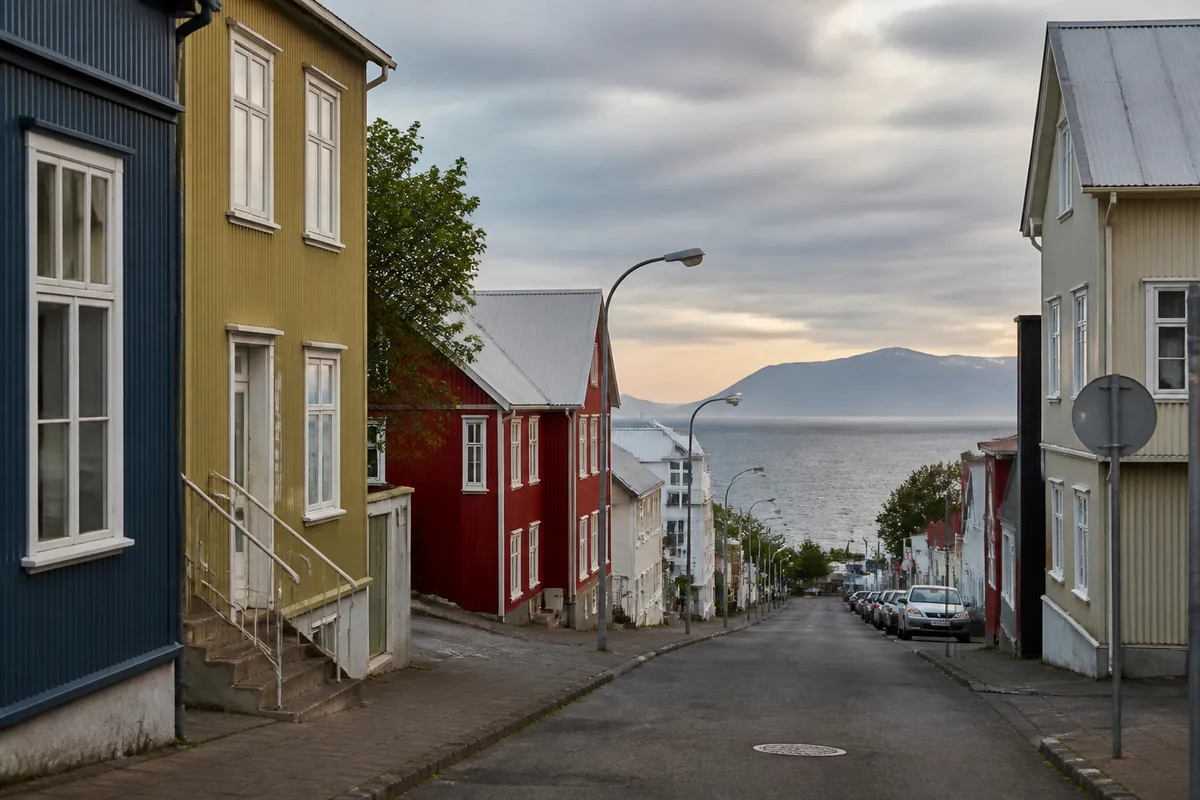
For a first discovery of the region, landscapes and itineraries can be compared in this file on the Scandinavian countries to discover, keeping the distinction between tourist use and geographical definition.
Useful Sources to Consult
Geographical definitions rarely change, but institutions do not always use the same boundaries. These references allow you to verify the vocabulary before an assignment, article, or itinerary preparation.
- Nordic Council → definition of the Nordic region → check the list of five states and associated territories.
- Encyclopaedia Britannica → historical and geographical definition of Scandinavia → distinguish the strict core from the broader usage.
- French Senate → institutional status of Greenland and the Faroe Islands → do not count these territories as additional sovereign states.
.magic-lb-overlay{position:fixed;inset:0;background:rgba(15,23,42,.92);display:none;align-items:center;justify-content:center;z-index:99999;cursor:zoom-out;padding:20px}
.magic-lb-overlay.open{display:flex}
.magic-lb-overlay img{max-width:95vw;max-height:95vh;object-fit:contain;border-radius:8px;box-shadow:0 8px 32px rgba(0,0,0,.5)}
.magic-lb-close{position:absolute;top:16px;right:20px;color:#fff;background:rgba(0,0,0,.5);border:none;width:40px;height:40px;border-radius:50%;font-size:24px;cursor:pointer;display:flex;align-items:center;justify-content:center}
.magic-lb-close:hover{background:rgba(0,0,0,.8)}
.wp-block-image img{cursor:zoom-in;transition:transform .15s ease}
.wp-block-image img:hover{transform:scale(1.01)}
.magic-img-link{display:inline-block;text-decoration:none}
(function(){
var ov=document.getElementById(‘magic-lb’);if(!ov)return;
var img=ov.querySelector(‘img’),btn=ov.querySelector(‘.magic-lb-close’);
var L={fr:’Fermer’,es:’Cerrar’,en:’Close’,pt:’Fechar’,it:’Chiudi’,de:’Schlie\u00dfen’,nl:’Sluiten’,ca:’Tancar’};
btn.setAttribute(‘aria-label’,L[(document.documentElement.lang||”).slice(0,2).toLowerCase()]||’Close’);
function open(src){img.src=src;ov.classList.add(‘open’);document.body.style.overflow=’hidden’}
function close(){ov.classList.remove(‘open’);img.src=”;document.body.style.overflow=”}
document.addEventListener(‘click’,function(e){
var a=e.target.closest(‘a.magic-img-link’);
if(a){e.preventDefault();open(a.getAttribute(‘href’));return}
var i=e.target.closest(‘.wp-block-image img’);
if(i&&!e.target.closest(‘a’)){e.preventDefault();open(i.currentSrc||i.src)}
});
ov.addEventListener(‘click’,function(e){if(e.target===ov||e.target===btn)close()});
document.addEventListener(‘keydown’,function(e){if(e.key===’Escape’)close()});
})();