.synthesis { max-width: 640px; margin: 2em auto; padding: 1.5em 1.8em; color: #78350f; font-family: “Inter”, “Segoe UI”, sans-serif; text-align: left; position: relative; box-sizing: border-box; background: #fffaf0; border: 1px solid #b45309; border-left: 6px solid #b45309; border-radius: 8px; box-shadow: 0 8px 24px rgba(251, 191, 36, 0.15); }
.synthesis h2, .synthesis .synthesis-header { font-size: 1.15em; font-weight: 700; margin-bottom: 0.6em; color: #b45309; }
.synthesis p, .synthesis li { font-size: 1em; line-height: 1.65; margin: 10px; }
.synthesis strong { color: #451a03; }
.synthesis table { width: 100%; border-collapse: collapse; }
.synthesis th { background: rgba(180, 83, 9, 0.12); color: #b45309; text-align: left; }
.synthesis td, .synthesis th { padding: 8px 12px; border-bottom: 1px solid rgba(180, 83, 9, 0.18); vertical-align: top; }
.synthesis tbody tr:nth-child(even) { background: rgba(180, 83, 9, 0.05); }
.key-takeaways { max-width: 640px; margin: 2em auto; padding: 1.5em 1.8em; color: #78350f; font-family: “Inter”, “Segoe UI”, sans-serif; text-align: left; position: relative; box-sizing: border-box; background: #fffaf0; border: 1px solid #b45309; border-left: 6px solid #b45309; border-radius: 8px; box-shadow: 0 8px 24px rgba(251, 191, 36, 0.15); }
.key-takeaways h2, .key-takeaways .key-takeaways-header { font-size: 1.15em; font-weight: 700; margin-bottom: 0.6em; color: #b45309; }
.key-takeaways p, .key-takeaways li { font-size: 1em; line-height: 1.65; margin: 10px; }
.key-takeaways strong { color: #451a03; }
.key-takeaways ul { list-style: none; padding-left: 0; }
.key-takeaways li { margin: 0.45em 0; padding-left: 0.2em; }
.mg-callout{margin:1.5em 0;padding:.9em 1.1em;border:1px solid;border-left-width:4px;border-radius:10px;font-size:.97em;line-height:1.65}.mg-callout>:first-child{margin-top:0}.mg-callout>:last-child{margin-bottom:0}.mg-callout__label{display:block;margin:0 0 .35em;font-weight:700;font-size:.82em;letter-spacing:.03em;text-transform:uppercase}.mg-callout__label::before{margin-right:.45em;font-size:1.05em;vertical-align:-.06em}.mg-callout–info{background:#eff6ff;border-color:#bfdbfe;color:#1e3a5f}.mg-callout–info .mg-callout__label{color:#2563eb}.mg-callout–info .mg-callout__label::before{content:”\2139\FE0F”}.mg-callout–tip{background:#f0fdf4;border-color:#bbf7d0;color:#14532d}.mg-callout–tip .mg-callout__label{color:#15803d}.mg-callout–tip .mg-callout__label::before{content:”\1F4A1″}.mg-callout–warning{background:#fffbeb;border-color:#fde68a;color:#7a4a10}.mg-callout–warning .mg-callout__label{color:#b45309}.mg-callout–warning .mg-callout__label::before{content:”\26A0\FE0F”}.mg-callout–danger{background:#fef2f2;border-color:#fecaca;color:#7f1d1d}.mg-callout–danger .mg-callout__label{color:#dc2626}.mg-callout–danger .mg-callout__label::before{content:”\1F6D1″}.mg-proscons{display:grid;grid-template-columns:1fr 1fr;gap:16px;margin:1.5em 0}@media(max-width:560px){.mg-proscons{grid-template-columns:1fr}}.mg-proscons__col{padding:.9em 1.1em;border:1px solid;border-radius:10px}.mg-proscons__title{display:flex;align-items:center;gap:.4em;margin:0 0 .5em;font-weight:700;font-size:.9em;letter-spacing:.02em}.mg-proscons__col ul{margin:.3em 0 0;padding-left:1.15em}.mg-proscons__col li{margin:.3em 0;line-height:1.55}.mg-proscons__col–pro{background:#f0fdf4;border-color:#bbf7d0;color:#14532d}.mg-proscons__col–pro .mg-proscons__title{color:#15803d}.mg-proscons__col–pro .mg-proscons__title::before{content:”\2705″}.mg-proscons__col–con{background:#fef2f2;border-color:#fecaca;color:#7f1d1d}.mg-proscons__col–con .mg-proscons__title{color:#dc2626}.mg-proscons__col–con .mg-proscons__title::before{content:”\274C”}ol.mg-steps{list-style:none!important;counter-reset:mgstep;margin:1.6em 0;padding-left:0!important}ol.mg-steps>li.mg-steps__item{counter-increment:mgstep;list-style:none!important;padding-left:0!important;padding-bottom:1.4em}ol.mg-steps>li.mg-steps__item:last-child{padding-bottom:0}ol.mg-steps>li.mg-steps__item>:last-child{margin-bottom:0}ol.mg-steps>li.mg-steps__item>.mg-steps__title{margin:0 0 .25em;font-weight:600}ol.mg-steps>li.mg-steps__item>.mg-steps__title::before{content:counter(mgstep) “. “;opacity:.45;font-weight:500;font-variant-numeric:tabular-nums}ol.mg-steps>li.mg-steps__item:not(:has(.mg-steps__title))::before{content:counter(mgstep) “. “;opacity:.45;font-weight:500;font-variant-numeric:tabular-nums}.mg-kpis{display:grid;grid-template-columns:repeat(auto-fit,minmax(140px,1fr));gap:14px;margin:1.5em 0}.mg-kpi{padding:1em .9em;border:1px solid #e5e7eb;border-radius:12px;background:#f9fafb;text-align:center}.mg-kpi__value{display:block;font-size:1.7em;font-weight:800;line-height:1.15;color:#111827}.mg-kpi__label{display:block;margin-top:.35em;font-size:.85em;color:#6b7280;line-height:1.35}
.wp-block-image,.ai-image{margin-bottom:1.75em}.wp-block-image>figcaption,.ai-image>figcaption{margin-top:.5em}
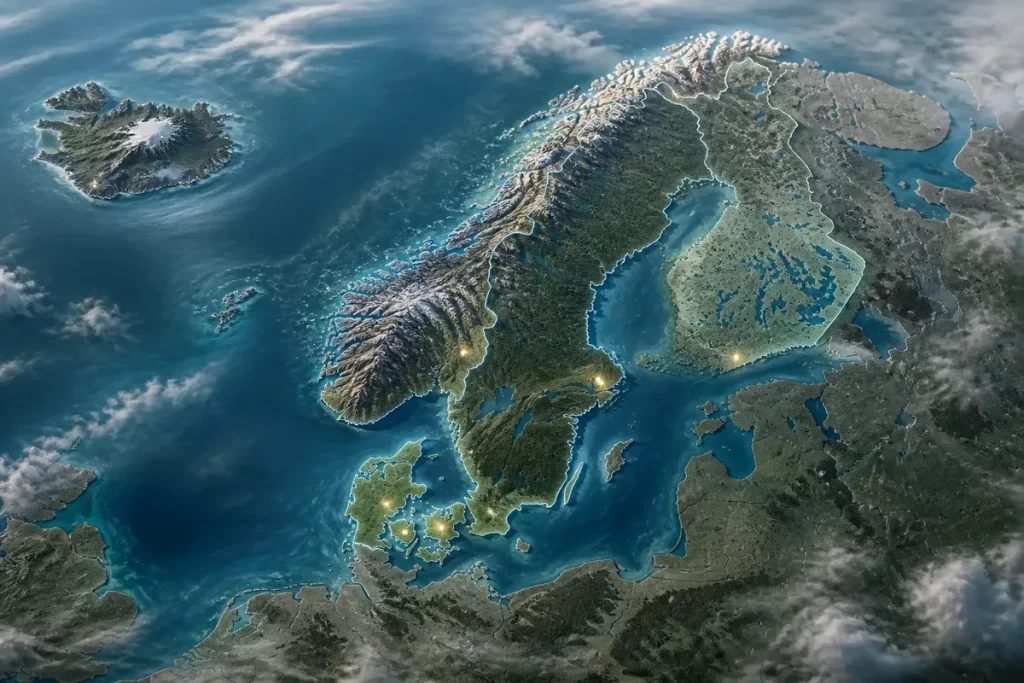
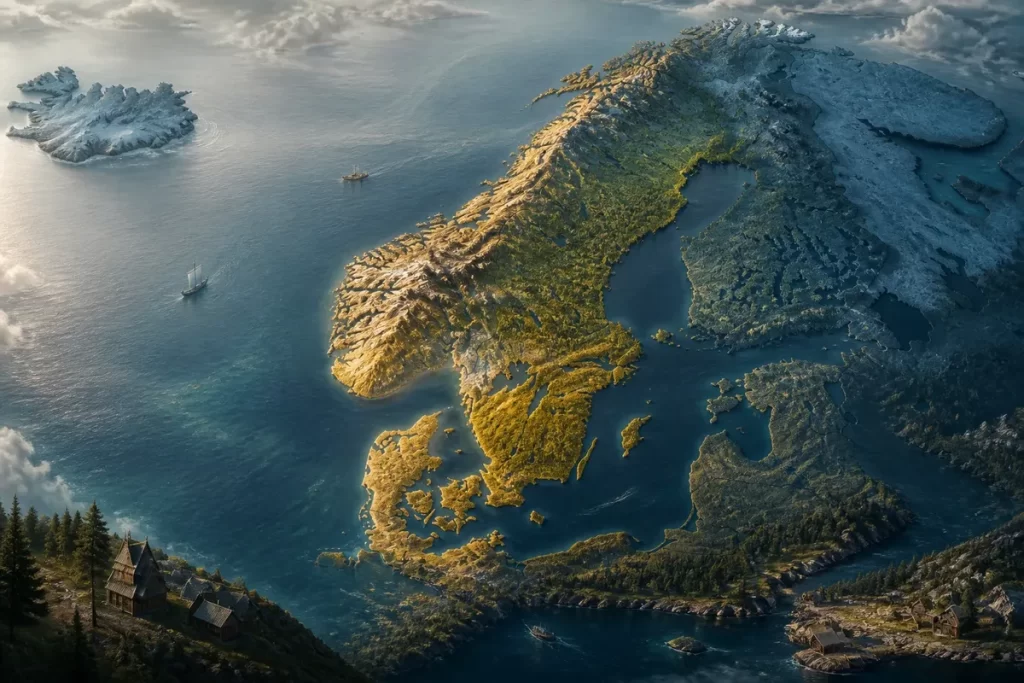
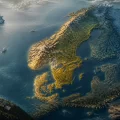
Three countries form the heart of Scandinavia: Denmark, Norway, and Sweden. They are called Scandinavian countries because the term “Scandinavia” historically and culturally refers to a group in Northern Europe mainly composed of these three states. Finland and Iceland are sometimes included in a broader sense, but they generally belong to the Nordic countries.

derivative work: Russavia
derivative work: Russavia / Wikimedia Commons

The confusion arises from the fact that geographical, historical, linguistic, and tourist usages do not always retain the same scope. To understand why they say Scandinavian countries, it is therefore necessary to distinguish the cultural region, the Scandinavian Peninsula, and the broader political entity called the Nordic countries.
| 📌 | Strict definition: Scandinavia includes Denmark, Norway, and Sweden. |
|---|---|
| 🧭 | Region concerned: a historical and cultural area of Northern Europe. |
| 🗣️ | Related languages: Danish, Norwegian, and Swedish belong to the North Germanic branch. |
| 🌍 | Nordic countries: this broader group also includes Finland and Iceland. |
| 🏔️ | Scandinavian Peninsula: it mainly corresponds to the territories of Norway and Sweden. |
| ⚠️ | Note of caution: an expanded tourist itinerary does not change the strict geographical definition. |
Which countries are Scandinavian in the strict sense?
In the most precise sense, the Scandinavian countries are Denmark, Norway, and Sweden. This grouping is based on a shared history, monarchies and kingdoms long connected, as well as closely related languages. Scandinavia therefore designates a cultural region before it describes a mere shape on a map.
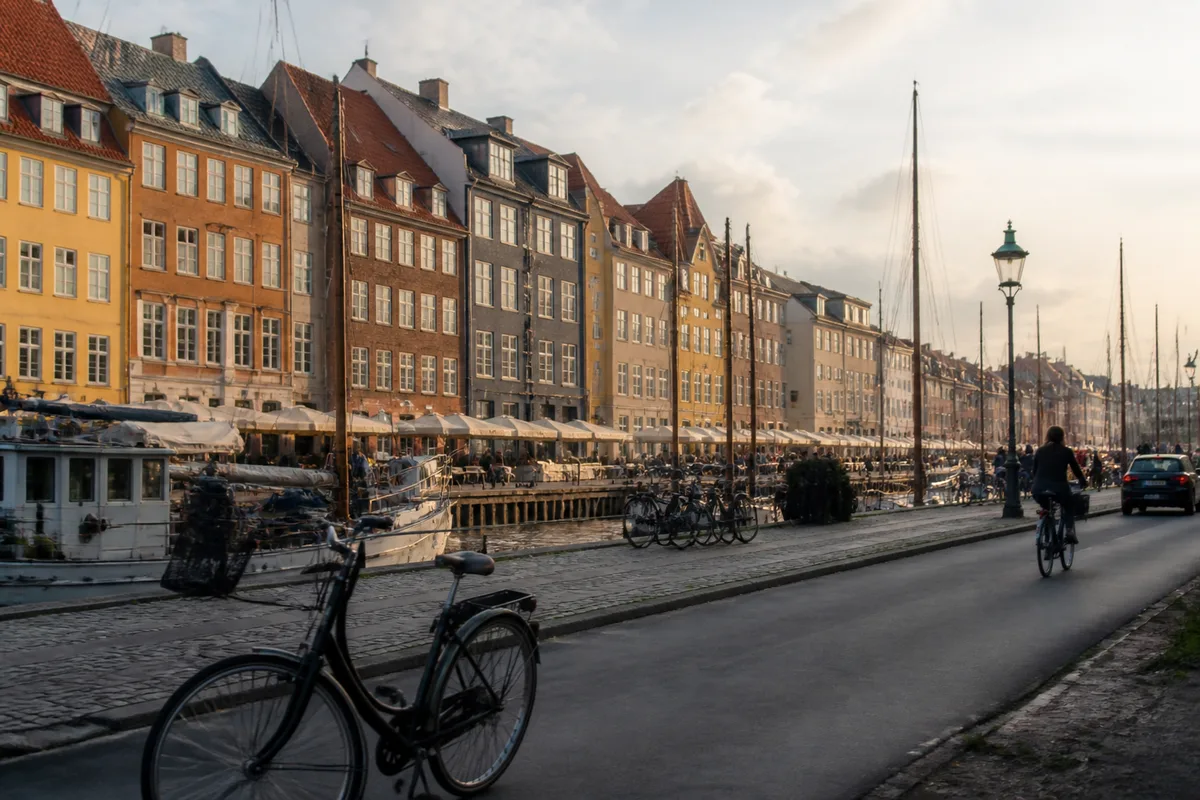
Denmark, Norway, and Sweden
The Scandinavian core consists of three countries. Denmark occupies the southern part of this group, with the Jutland Peninsula and an archipelago facing the Baltic Sea and the North Sea. Norway and Sweden mainly extend over the Scandinavian Peninsula.
Denmark is therefore not excluded because it is not located on the Scandinavian Peninsula. Scandinavia is a broader regional concept than this peninsula. This distinction explains why Copenhagen belongs to Scandinavia even though the Danish capital is situated outside the peninsula bearing the same adjective.
On site, political borders remain very visible, while cultural similarities circulate easily between the three countries. Maritime exchanges have brought the populations closer. Dynastic unions have also woven lasting ties. The language strengthens this closeness.
Why have these three countries been grouped together?
The grouping of Denmark, Norway, and Sweden comes from a combination of historical ties, linguistic proximities, and an evolution of the term Scandinavia. None of these elements alone is sufficient: it is their overlap that has transformed an old geographical name into a regional cultural designation.
A shared history around the North Sea and the Baltic
The Scandinavian kingdoms shared rivalries, alliances, and periods of political union. The sea did not only separate the territories: it facilitated travel, trade, and power flows between the Danish, Norwegian, and Swedish coasts.
This history explains the strength of the grouping in European narratives. It does not erase national differences. It simply provides a common framework for societies that have long evolved in the same northern space.
The word has thus left the vocabulary of physical geography alone. Today it designates a regional proximity, as when one speaks of the Balkans or the Baltic countries without claiming that all their inhabitants form a single nation. The region retains distinct identities.
Related languages
Danish, Norwegian, and Swedish belong to the North Germanic language group. Their grammars and part of their vocabulary show historical similarities, which often facilitates understanding between speakers, even if this understanding varies according to accent, habit, and context.
A Dane therefore does not automatically understand every Norwegian or Swedish sentence. Yet, regional mutual intelligibility remains an important marker of proximity, especially between written languages and in everyday exchanges.
On site, linguistic differences are quickly noticed in announcements, media, and conversations. They do not prevent a common culture from being built. They mainly remind us that a language family never means a single language.
An ancient name that became regional
The name Scandinavia has ancient forms attested in antique texts, notably in a Latin form associated with Pliny the Elder in the 1st century AD. The exact etymology remains debated: several connections have been proposed, linked to place names or old Germanic roots.

Fugger Binder / Venetian Apple Binder / Wikimedia Commons
We must therefore separate two levels. The ancient existence of the name is a historical element. The precise meaning of its roots remains a debated linguistic question. Presenting a single translation as a certainty oversimplifies the history of the term.
The shift toward a cultural meaning happened gradually, when the similarities between the kingdoms and their populations counted as much as the location. The word no longer describes only a territory: it also evokes a history, languages, and regional relations.
What is the difference between Scandinavia and the Nordic countries?
The Nordic countries form a group of five states: Denmark, Finland, Iceland, Norway, and Sweden. Scandinavia in the strict sense includes only three of them. This distinction is the most useful to avoid mistakes, as Finland and Iceland are Nordic without belonging to the traditional Scandinavian core.
Finland and Iceland in a Broad Sense
Finland is often grouped with Scandinavia in brochures, media, or international conversations because it fully belongs to Northern Europe and shares historical ties with its neighbors. However, its main language, Finnish, is not part of the North Germanic language group.

derivative work: Hayden120 (talk) / Wikimedia Commons
Iceland is also regularly included in broad usages. Its history is strongly linked to Norway and the North Atlantic world, while its language belongs to the North Germanic group. This historical proximity explains its frequent association with Scandinavia, even though the term Nordic countries remains more precise to include it.
Nordic cooperation institutions have reinforced this modern distinction. The Nordic Council was created in 1952, within a framework that brings together the five Nordic countries, as well as associated autonomous territories. This institutional framework therefore concerns a broader set than Scandinavia in the strict sense.
To deepen the scopes and usages, the article dedicated to Scandinavian and Nordic countries allows comparing the two expressions without mixing them.
What Confusions Should Be Avoided?
The main mistake is to use Scandinavia as an automatic synonym for all of Northern Europe. A trip passing through Helsinki, Reykjavik, or Tallinn can be commercially presented as a Scandinavian tour, but this extended itinerary does not change the strict geographical meaning of the term.
Scandinavia and the Scandinavian Peninsula
The Scandinavian Peninsula mainly corresponds to Norway and Sweden. Scandinavia adds Denmark, which is located to the south and east of this peninsular area. The name of the cultural region is therefore not limited to the physical shape of the peninsula.

Scandinavia and Nordic Countries
Saying “Nordic countries” when you want to include Finland and Iceland is the clearest formulation. Saying “Scandinavia” for the five states is a broad usage, understandable in certain contexts, but less precise in a geographical or historical text.
The confusion also appears in city names. Stockholm, Oslo, and Copenhagen are Scandinavian capitals. Helsinki and Reykjavik are Nordic capitals. Tourist itineraries can bring them together without changing their regional affiliation.

Touristic uses sometimes broaden the scope
A brochure may associate Norwegian fjords, Stockholm, Helsinki, and Reykjavik under the same commercial label. This presentation helps sell a coherent itinerary, but it follows a travel logic and not a terminological definition.

Locally, inhabitants generally distinguish their country and national identity, even if regional cooperation is strong. A common route does not create identical belonging. This is why it is better to speak of Northern Europe or Nordic countries when the itinerary goes beyond the three central countries.

For a detailed list of territories often added in broad uses, the page on the five Scandinavian countries allows you to see where the term’s broadening begins.
.magic-lb-overlay{position:fixed;inset:0;background:rgba(15,23,42,.92);display:none;align-items:center;justify-content:center;z-index:99999;cursor:zoom-out;padding:20px}
.magic-lb-overlay.open{display:flex}
.magic-lb-overlay img{max-width:95vw;max-height:95vh;object-fit:contain;border-radius:8px;box-shadow:0 8px 32px rgba(0,0,0,.5)}
.magic-lb-close{position:absolute;top:16px;right:20px;color:#fff;background:rgba(0,0,0,.5);border:none;width:40px;height:40px;border-radius:50%;font-size:24px;cursor:pointer;display:flex;align-items:center;justify-content:center}
.magic-lb-close:hover{background:rgba(0,0,0,.8)}
.wp-block-image img{cursor:zoom-in;transition:transform .15s ease}
.wp-block-image img:hover{transform:scale(1.01)}
.magic-img-link{display:inline-block;text-decoration:none}
(function(){
var ov=document.getElementById(‘magic-lb’);if(!ov)return;
var img=ov.querySelector(‘img’),btn=ov.querySelector(‘.magic-lb-close’);
var L={fr:’Fermer’,es:’Cerrar’,en:’Close’,pt:’Fechar’,it:’Chiudi’,de:’Schlie\u00dfen’,nl:’Sluiten’,ca:’Tancar’};
btn.setAttribute(‘aria-label’,L[(document.documentElement.lang||”).slice(0,2).toLowerCase()]||’Close’);
function open(src){img.src=src;ov.classList.add(‘open’);document.body.style.overflow=’hidden’}
function close(){ov.classList.remove(‘open’);img.src=”;document.body.style.overflow=”}
document.addEventListener(‘click’,function(e){
var a=e.target.closest(‘a.magic-img-link’);
if(a){e.preventDefault();open(a.getAttribute(‘href’));return}
var i=e.target.closest(‘.wp-block-image img’);
if(i&&!e.target.closest(‘a’)){e.preventDefault();open(i.currentSrc||i.src)}
});
ov.addEventListener(‘click’,function(e){if(e.target===ov||e.target===btn)close()});
document.addEventListener(‘keydown’,function(e){if(e.key===’Escape’)close()});
})();
Articles similaires :
 What are the 5 Scandinavian countries? List and explanations
 Scandinavian countries and Nordic countries: what are the differences?
 Map of Scandinavian countries: location, borders, and capitals
 6 Scandinavian countries with breathtaking landscapes
 Why do we say the Scandinavian countries? Origin and definition